Jim’s Intro to Saucer Pass
Hi folks, Jim here, the only commentator who once tried a saucer pass and ended up “passing” both my tea cup and saucer all over my co-announcer. Apparently, I was focused on the wrong saucer.
What is a saucer pass?
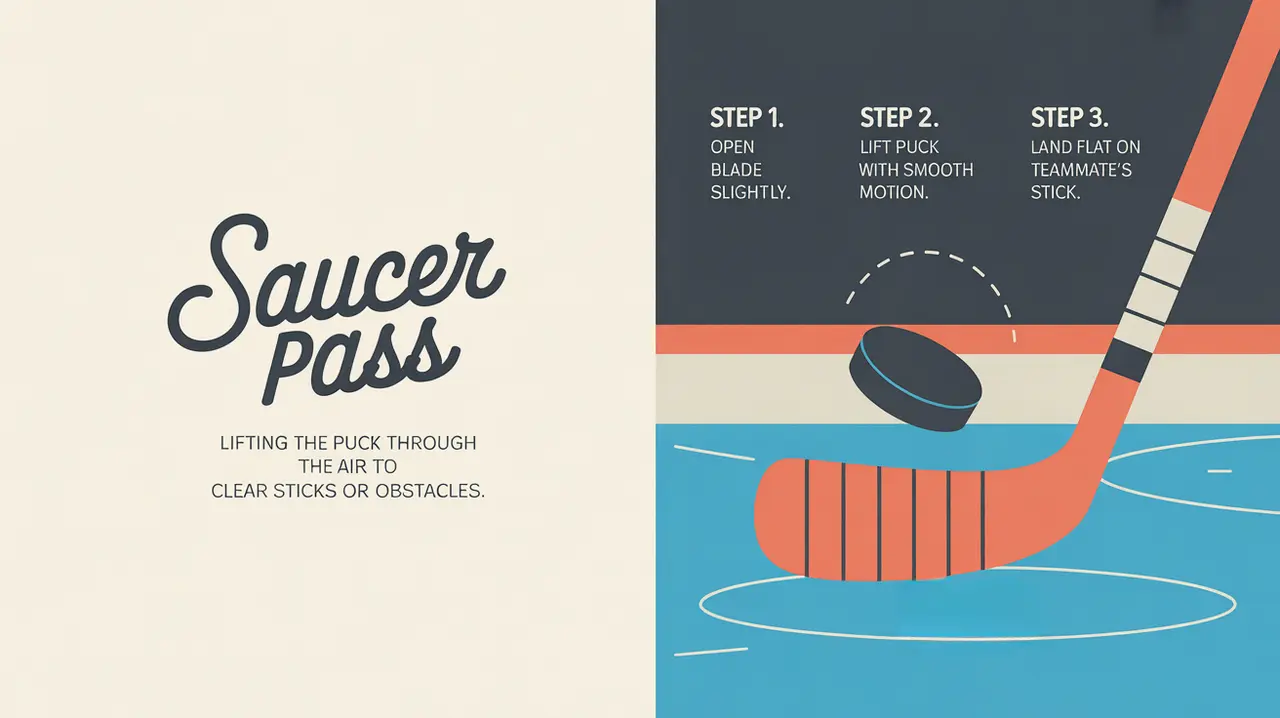
A saucer pass is a pass where the puck is lifted slightly off the ice to glide through the air like a flying saucer, usually to clear sticks or traffic in the passing lane. It’s a staple in higher levels of play, allowing crisp puck movement through congested areas.
How does it work?
The saucer pass relies on blade angle, touch, and follow-through:
- Blade Angle: Open the blade slightly to get under the puck.
- Hand Position: Keep hands comfortable and loose for control.
- Puck Placement: Start the puck toward the heel of the blade.
- Lifting Motion: Sweep through the puck with a gentle upward motion, like skipping a stone.
- Spin Control: Add a slight rolling motion to create spin, which stabilizes the puck mid-air.
- Targeted Follow-Through: Point toward your teammate’s stick to guide the flight path.
How do you make good decisions with it?
- Clear Obstacles: Use saucer passes to hop over defensive sticks or sprawling bodies.
- Match Height to Distance: Short saucers should barely lift, while longer ones need more air.
- Pick Your Moments: Don’t saucer just to look fancy. Use it when a flat pass isn’t available.
- Account for Landing: Make sure the puck lands flat and controllable for your teammate.
- Read Lanes: Saucer passes work best when the passing lane is partially obstructed, not fully closed.
How do you master it?
Mastering the saucer pass takes touch drills and repetition. Players start with short, soft saucers over sticks laid on the ice, gradually increasing distance and speed. Precision landing is as important as the lift itself.
What does it look like when done right?
A perfect saucer pass looks smooth and floating, with the puck gliding through the air in a controlled arc before landing flat on a teammate’s blade. It bypasses sticks like magic but hits the target cleanly.
Commentator’s Corner
Jim’s Take
A clean saucer pass is like a perfectly thrown alley-oop. The crowd might not always cheer, but the bench sure does.
Parent Tip
Set up sticks or obstacles at home or during practice for players to pass over. Repetition builds the touch needed for game situations.
Player Tip
Start with short distances and focus on a smooth, spinning release. Consistency comes from feel, not force.
A Final Thought
The saucer pass adds finesse to your playmaking. Master it, and you’ll thread passes through traffic that make defenders wonder how the puck even got there.